An AI agent that investigates incidents on its own

Trace works through your SIEM alerts like a seasoned analyst: it connects events, checks them across every system and closes out the routine. Every verdict comes with evidence, and anything doubtful goes to a human.

min

per investigation, vs. 30–90 minutes by hand

of 30

correct verdicts on 30 BlueSec incidents

2 minutes per investigation, vs. 30–90 minutes by hand. 30 of 30 correct verdicts on 30 BlueSec incidents.

Editions

Which Trace fits you

Start with what you already have.

You run a SOC and a SIEM

Trace SOC

A tier-1 autopilot on top of your SIEM. It closes routine alerts on its own, with evidence, and hands disputed ones to an analyst.

Works with

Also R-Vision SIEM, KOMRAD, Ankey SIEM, Elastic and OpenSearch. Custom SIEM via API or event export.

No in-house security team

Trace Watch

An AI on-call analyst through your insurer or MSSP: a verdict in minutes, help in the first minutes of an attack.

Works with

You’re rolling out AI agents

Trace AgentResearch

Reconstructs what your AI agent did and why: what data it read and where someone tried to lead it astray.

Status
Research program, looking for partners
Become a partner
How it works

Inside an investigation

An alert arrives from your SIEM. Trace takes it from there, like a tier-1 analyst.

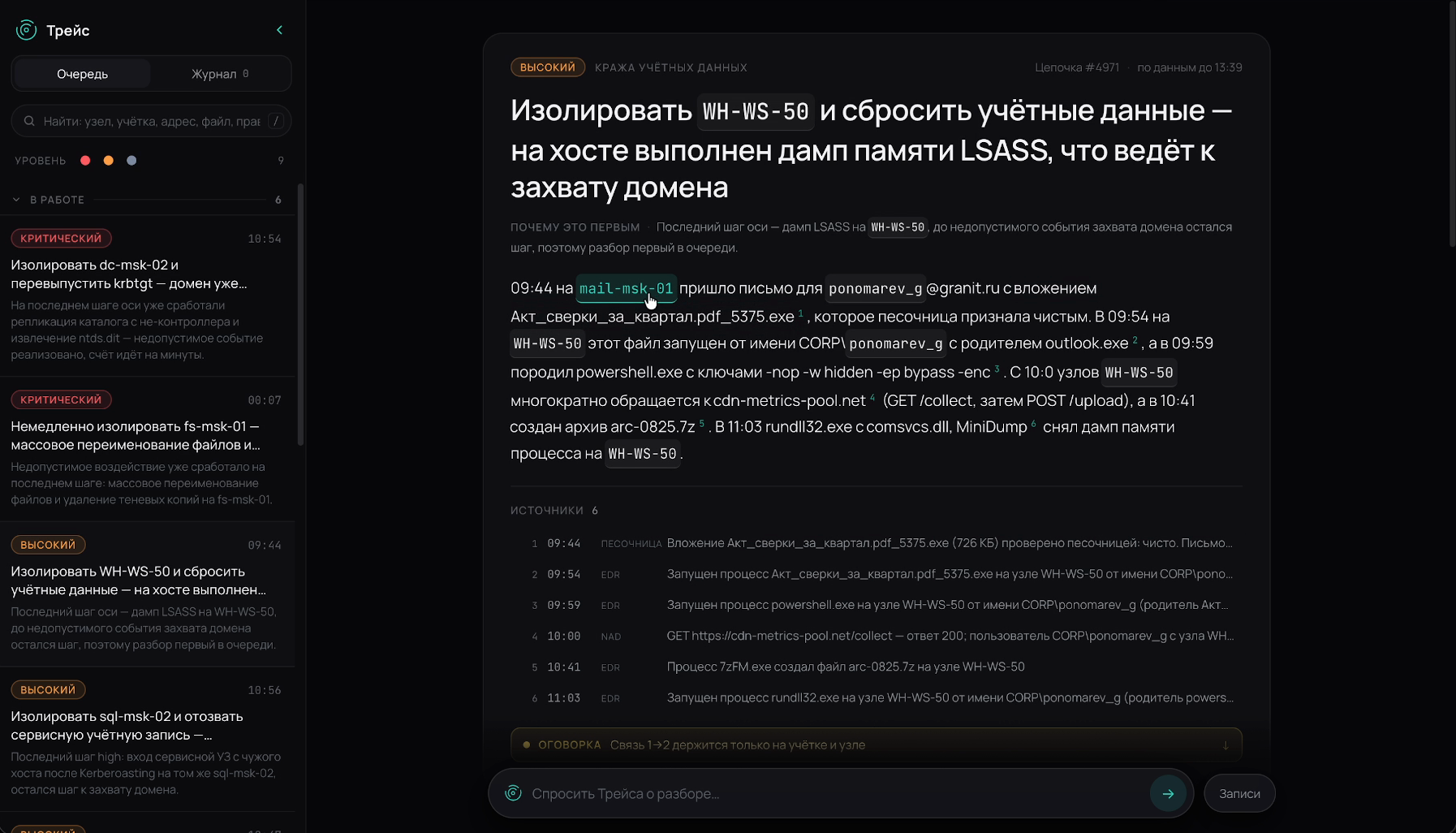
Demo screen: the investigation queue on the left; on the right, investigation WH-WS-50 and why it is first in line
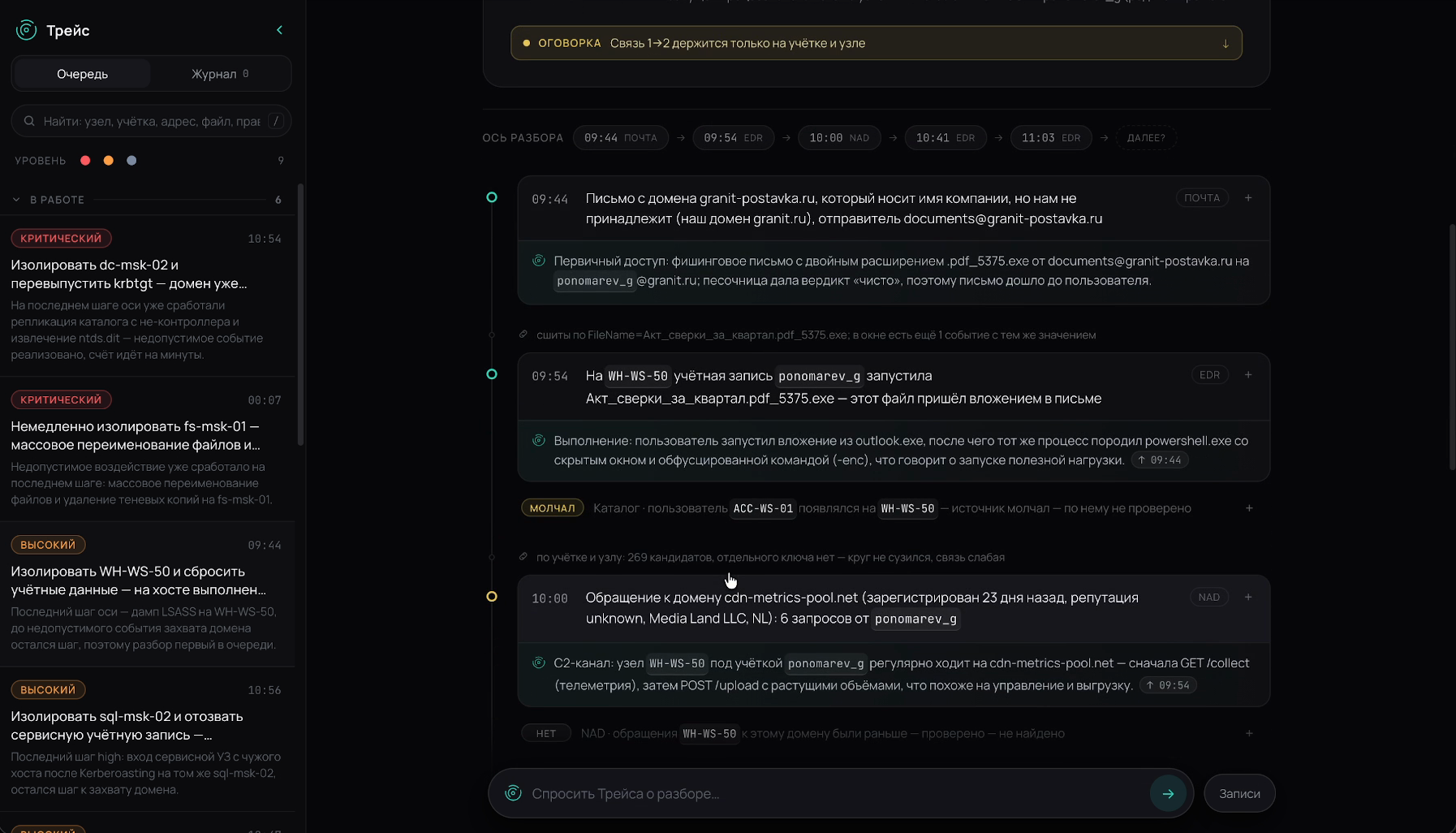
Demo screen: the WH-WS-50 event chain and six sources: sandbox, EDR, NAD
Demo screen: the step-by-step investigation timeline, linking the email to the attachment launch by file name
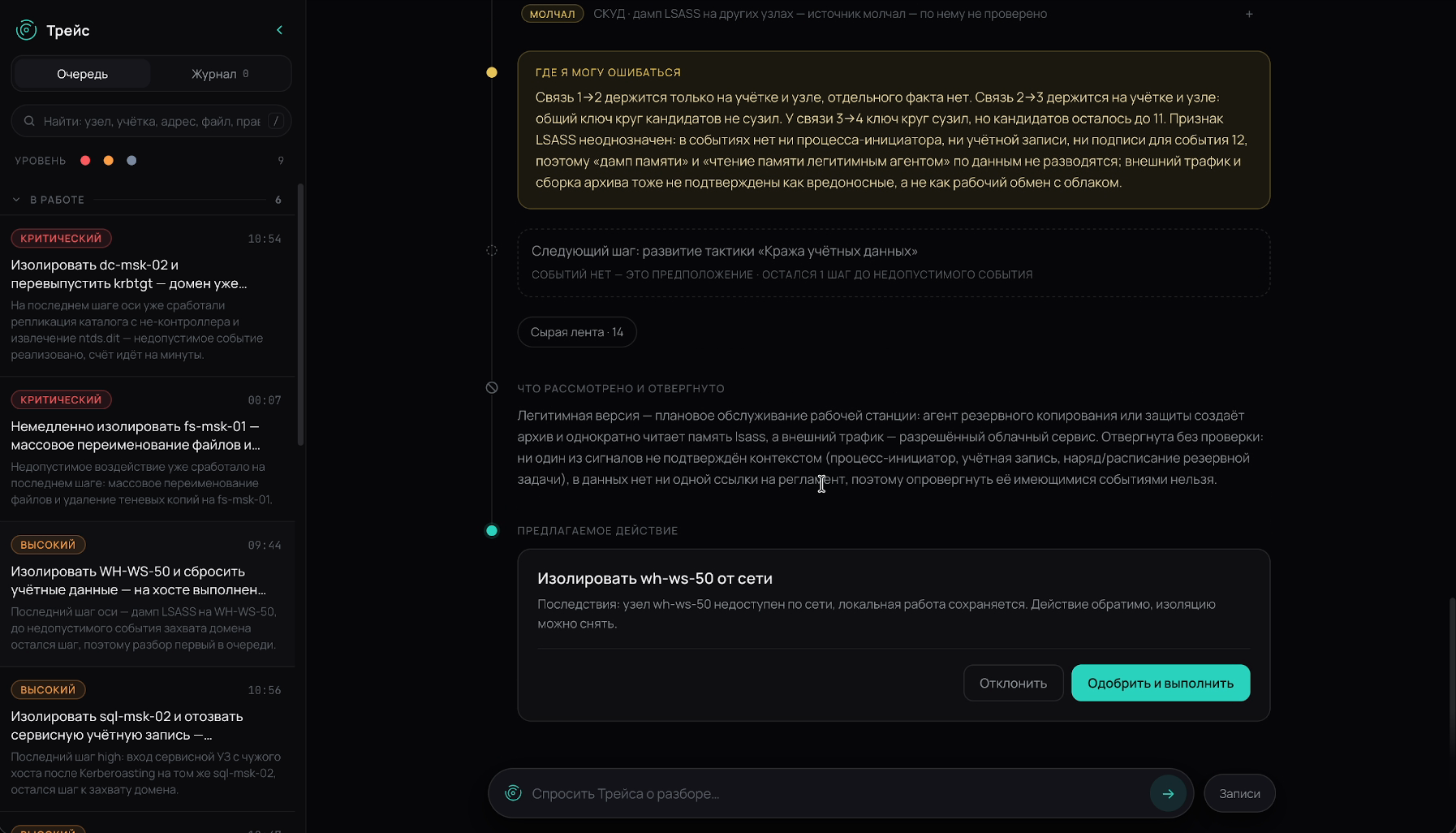
Demo screen: what was considered and ruled out, and the proposed action “Isolate wh-ws-50 from the network” with “Reject” and “Approve and run” buttons

Demo screens (in Russian), investigation WH-WS-50. Steps auto-advance; click to pick one.

Why trust it

Every verdict is verifiable

Trace doesn’t ask for your trust. Evidence sits next to every verdict, and where it couldn’t verify something, it says so. In all three editions.

Demo screen, investigation WH-WS-50: the verdict “Isolate WH-WS-50 and reset credentials: an LSASS memory dump ran on the host, which leads to domain takeover”, six sources below it and the caveat “Link 1→2 rests only on the account and the host”
Demo screen (in Russian), investigation WH-WS-50.

Three outcomes, not two: when there’s not enough data or the verdict is disputed, a human makes the call.

Pilot

Pilot and rollout

  1. Step 1Alongside your analysts

    Investigates every alert alongside your analysts, but closes nothing on its own.

  2. Step 2Autopilot

    Closes low-priority routine alerts by itself and hands disputed ones to an analyst.

  3. Step 3Decide on the numbers

    Measured results on your own incidents. Then you decide.

The pilot is free

One month on your data. You get measured results on your own incidents. From you: one SOC’s data for the month and one analyst for two weeks.
On-premises, inside your perimeter, on open-weight models. Read-only: a human approves every action.

Write to us. We reply within a day.

info@trace-soc.ru
FAQ

What to know before a pilot

Don’t see your question? Email us at info@trace-soc.ru.

What if Trace gets it wrong?

It’s built for that. There are three outcomes, not two: when there’s not enough data or the verdict is disputed, the investigation goes to an analyst. Trace closes only low-priority routine alerts on its own, and an analyst spot-checks what it closed. High-priority alerts are always decided by a human. Every decision is logged with its evidence, so it can be reviewed and reopened.

Where does our data go?

Nowhere. Trace is deployed on-premises, on your hardware, and runs without cloud APIs. Personal data never leaves your perimeter. In your systems, Trace is read-only: it writes nothing, and a human approves every action.

Does Trace help with compliance?

It helps you meet security monitoring and incident response requirements, including Russian ones: FSTEC orders for critical information infrastructure and the Bank of Russia standard GOST R 57580.1.

What models are inside?

Open-weight language models deployed inside your perimeter. Links between events are scored by an algorithm, not a neural network: how rare the coincidence is in your company’s history. One model writes the investigation, and a second model is required to argue against it.

How much does it cost after the pilot?

We price it after the pilot, based on alert volume. By then you have measured results on your own incidents to base the decision on. The Trace SOC pilot is free.

How is Trace different from SOAR or an AI assistant in a SIEM?

SOAR runs playbooks that people wrote for it. Trace investigates: it gathers events across systems on its own, links them and explains its verdict. An AI assistant in a SIEM retells the alert. Trace attaches evidence to the verdict, says where it couldn’t verify, and never treats text inside the data as proof.

What do you need from us for a pilot?

One SOC’s data for a month and one analyst for two weeks, with read-only access. Today Trace works with MaxPatrol-format data; we’ll connect another SIEM with a connector during the pilot. You get measured results on your own incidents.